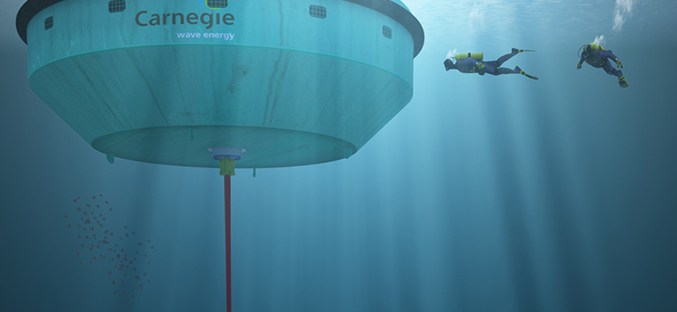
Australia’s wave energy system proposal, the Perth Wave Energy Project, utilizes the motion and pressure of the ocean’s waves to convert into an energy source on land. The method functions by placing generators that acts as buoys in the water that essentially move back and forth, up and down with the currents to then translate the wave’s energy into electricity. As of March 15, 2015 the first wave farm of its caliber is up and running in Western Australia, and is projected to continue growth immensely in the coming years. The project is a groundbreaking new tool for energy and water desalination that utilizes Australia’s wave-energy technology, CETO, named after the Greek ocean goddess, to produce zero-emission power and works towards reducing the overall need for fossil fuels. CETO has been made possible through various grants and funding by the Western Australian government, with hopes of successfully developing a full transition of the removal of reliance on fossil fuels for energy. Almost 60% of the world’s population is located near the shoreline, so CETO has the potential to reach more than half of our population and provide a sustainable energy source through capturing the natural motion of waves and transforming them into energy. Although the buoy units are large, they would be placed in deep water, minimalizing any obstruction to views near the ocean or the impact of potential destruction from breaking waves on the surface of the water. This technology could revolutionize the way our future world is powered, and shines light on the potential to eliminate the use of fossil fuels and other toxic products that provide the necessary energy sources needed for human sustainability.
The CETO technology model functions solely from the cooperation between our knowledge of predicted wave schedules and the translation of such energy back onto land. By utilizing resources in the water to create resources on land, CETO is directly contributing to the UN Sustainable Developmental Goals focused on life on water and life on land. If the research, development and experimentation with the technology and infrastructure of CETO continue to progress, it is highly likely that this energy resource could replace other forms of energy, such as fossil fuels, that negatively impact our environment; thus, slowly returning our planet back to a healthier state.
Rose Kazanowski
Carnegie Wave Energy. (2015). Retrieved April, 2016, from http://carnegiewave.com/ Casey, T. (2015, March 15).
First-Of- Its-Kind Wave Energy Farm For Largest Naval Base In Australia. Clean Technica. Retrieved April, 2016, from http://cleantechnica.com/2015/03/15/first-kind- wave-energy- farm-largest- naval-base- australia/
Gallos, C. (2015). Carnegie’s CETO 5 Operational. Retrieved April, 2016, from http://www.wavehub.co.uk/latest-news/carnegies- ceto-5- operational
Ottaviano, M. (2016). Perth Wave Energy Project. Retrieved April, 2016, from http://arena.gov.au/project/perth-wave- energy-project/
Vorrath, S. (2016, January 27). Carnegie completes final milestone for CETO 5 Perth wave energy project. REneweconomy. Retrieved April, 2016, from http://reneweconomy.com.au/2016/carnegie-wave- 69826

 Sustainable Journeys