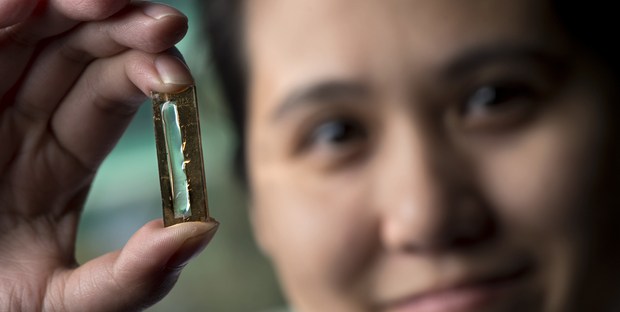
Batteries have long been the bane of the sustainable communities’ existence, but that may be about to change. Recently, a student at the University of California, Irvine accidentally invented a nanowire battery that charges faster and lasts longer. A group of researchers in the chemistry department were experimenting with replacing lithium with gold nanowires. Mya Le Thai, a PhD candidate at UCI, was the researcher who decided to coat the incredibly thin gold nanowires in manganese oxide and suspend them in a protectiveelectrolyte gel. Now what are either of those things? I honestly have no idea, but I understand the basic need. See in the past, the nanowires tended to crack after a certain amount of charges, but with this new gel coating the nanowires are more pliable and able to withstand hundreds of thousands of charges. Aside from the gel coating, these gold nanowires are very conductive and have a larger surface area for storing energy.
These new nanowire batteries take 200,000 charges, nearly 400 times more than lithium batteries! They aren’t exactly sure why or how it all works, but they do know that the mechanism is replicable. Over the last three months, they have recharged this gel- coated nanowire battery and haven’t seen any loss in power, capacity, or cracking in the nanowires. These batteries will change the way that clean energy is stored, electric cars are produced and run, as well as many more benefits to energy needs. By replacing lithium batteries with these nanowire batteries, it will save consumers money by not having to replace these batteries as frequently. Without the lithium, these batteries will also be less vulnerable to overheating or combustion. Another plus, without having to replace batteries as often, there will be less waste caused by batteries in land fills.
With the discovery being so new, there are no current public plans or predicted costs for replication at a larger scale. There is no doubt that this will change very soon, since these batteries will completely change commercial battery use and benefit the internationalcommunity.
Morgan McGoughran
[Mya Le Thai with her nanowire battery]. (2016). Retrieved from http://bigthink.com/robby-berman/scientists- accidentally-create- a-battery- that- can-outlast- your-device
 Sustainable Journeys