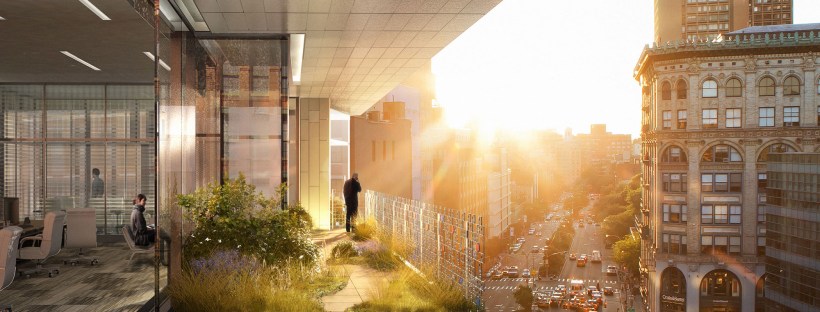
In New York City today, the desire and need for sustainable buildings has risen to astronomical numbers. With Mayor De Blasio’s OneNYC plan to build a stronger, more sustainable city, and previous Mayor Michael Bloomberg’s proposed energy efficiency plans, the growing number of green buildings popping up comes as no surprise. As of today, 70 percent of the city’s greenhouse emissions come from buildings such as schools, apartment, homes, workplaces, stores, etc. In order to reduce that percentage considerably, both current and future buildings will need to be modified or built with green and sustainable principles in mind. Energy efficiency is one of the top priorities, and by using more renewable sources of energy, we can lower greenhouse emissions, make buildings more affordable, and work toward a more sustainable city.
Today, more buildings are being designed or modified with not only sustainability in mind, but also maximizing the value of every inch of the structure. At the forefront of this environmental movement is Rich Cook, an architect and partner with COOKFOX, who has employed creative ways of connecting occupants with nature. In COOKFOX’s mission statement, it says that the company “seeks out projects of all scales and building types engaging in those through which we can explore inventive responses to environmental and social issues.” COOKFOX’s website has a wealth of information about the different projects they are working on now. They have clearly focused on the benefits of rooftop gardens, and hold an interest in the growing field of urban farming. On the rooftop of one of their NYC buildings, they have a small garden that grows corn, squash, and climbing beans. These three vegetables have been documented in different Native American tribes as growing and thriving the best when they are planted together. They have experimented with planting different heirloom seeds, but the most important point is that they have seen successful harvests every year since planting them. There are also many different types of flowers and plants in the garden, as well as a colony of bees for pollinating the plants and flowers that now contains 60,000 bees!
Cook believes that by incorporating these natural elements into buildings, you can also improve occupants’ mental and physical health. The “healing gardens” movement, which says that plants may have a calming effect on people, is now being employed inside, around, and now on top of these buildings. In offices where stress levels are high and the quality of mental health may be low, incorporating these green spaces can increase mental health, reduce stress levels, and improve air quality. He also says that by providing people with a connection to sunlight and nature, you give them a stronger sense of responsibility towards sustainable living. The hope is that the occupants of the building will help to contribute to sustainability and energy efficiency. Something as small as turning off lights when offices or rooms are not in use would save a ton of energy over timeif done on a building-wide scale.
COOKFOX’s designs incorporate green terraces and balconies in their buildings that is reminiscent of the Skyrise Greenery in Singapore. Singapore, whose slogan is “City in a Garden”, is a great example of how green spaces, energy efficiency, and technology can come together to create a more sustainable city. The greatest part about incorporating green spaces and LEED elements is that you can do it both on a small and large scale. On the smaller end, incorporating a garden on the roof or in the often- neglected area behind apartment buildings, can improve air quality and mental health of all occupants. On the largest scale, The Empire State Building is retrofitted for energy efficiency and has saved millions of dollars in energy costs since making the change. Other than energy efficiency, companies housed in the building like Shutterstock have yoga and massage rooms in their offices. This is pretty awesome because it highlights the connection between improving mental and physical health and environmental sustainability.
While designing with energy efficiency in mind is practically a standard now, including these green spaces is a more costly effort. At this time, it is harder to make a case for spending the extra money to provide these modifications that fall under the ‘improving mental health’ category. It’s a given that companies with enough capital, and a mind towards sustainability and the quality of the environment for their employees, can create this beautiful LEED certified meccas. For those with a smaller budget, making a bunch of short-term goals to achieve over time would help make the transition without breaking the bank. While it may be costly to create these spaces, they are a smart economic decision in the long run. These spaces, like rooftops, terraces, or even vertical gardens (along the walls), now serve a purpose that isn’t purely structural. Rooftop gardens can save money in both insulation and cooling costs, improve rainwater retention, improve air quality in cities where air pollution is a problem, and actually protectthe structural integrity of the roofs that they cover. Plus, they’re really pretty to lookat!
Morgan McGoughran
Weiss, L. (2016). NYC office buildings are buzzing with new green spaces. Retrieved from http://nypost.com/2016/04/19/nyc-office- buildings-are- buzzing-with- new- green-spaces/
Mission. (n.d.). Retrieved from http://www.cookfox.com/
 Sustainable Journeys