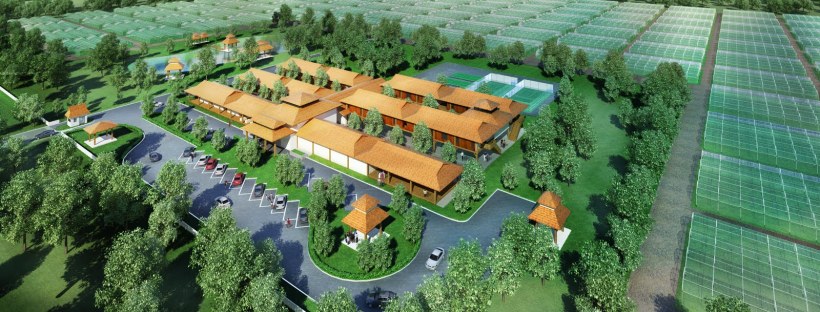
Smart Villages seek to provide the same opportunities and access for rural areas that urban cities maintain, making it possible for rural residents to have access to careers, clean water, healthcare, education, and communication—without leaving their remote and community-oriented villages. Originally, smart villages were created to tackle rural poverty in developing countries, through a public/private partnership with the UN Sustainable Development Solutions Network. This primary model, in Malaysia, is already being used all around the world to tackle impoverished areas in many different countries. The smart village in Malaysia has 100 homes built on about 50 acres of land, with access to educational, training, and recreational facilities, as well as sustainable agricultural systems, which provide a reliable food source and a supplementary income for residents. Additionally, this particular village has a four-level aquaculture system hosting guppies and algae, which provide food for larger fish like protein-rich tilapia. Filtered water from the fish tanks is also used to irrigate trees, flowers and crops. This system optimizes nutrient absorption, minimizes waste, and allows crops to grow on previously non-arable land. It uses a sort of “looping system” for a take on modern farming that can exist virtually anywhere, even in urban settings, making replication very realistic all around the world with few limitations.
This project helps provide a source of income for the intimate group of residents living in the village, and has essentially taken them out of poverty, while also improving their quality of living with more sustainable infrastructure, food, water, and agriculture. Smart villages are creating a network of small communities that make up a larger community of sustainable living that can eventually eliminate the pockets of severe poverty within and around the country. Further projects are being added to these villages, such as carbon reduction and biomass waste-to- wealth initiatives; demonstrating how these villages are simultaneously working towards many SDGs. These smart villages tackle the issues of poverty; hunger; good health and well-being; quality education; clean water and sanitation; affordable and clean energy, through self-sufficient solar panels complimented by biomass and hydro; decent work and economic growth within the village; sustainable innovation and infrastructure created to last; and most effectively model sustainable cities and communities that can be replicated all around the world. Finally, smart villages practice responsible consumption and production, ultimately affecting the global initiative to combat climate change.
Overall, this model is indeed very “smart” as it allows rural villages to have the same advantages of urbanized cities, on a much more intimate, community- based level. Each reproduced village can be tailored to its geographic location and cultural way of living because it is much more manageable and adaptable on a smaller scale. In terms of scalability, this project is intended to function on a small-scale in order to maintain the integrity and intimacy of the community practice and nature of the system. This particular model would still function if scaled slightly smaller or slightly larger, but ultimately, it would still need to be reproduced in a rural area with a community of residents that are all able to agree on a similar way of living as an entire unit
Alexa Bender
Knight, M. (2012, July 26). 'Smart Village' ties modernity with sustainable living. Retrieved May 22, 2016, from http://www.cnn.com/2012/07/26/world/asia/smart-village- malaysia/
Malaysia's 'Smart Villages' and 9 other proven ideas for sustainable development. (2014, September 17). Retrieved May 22, 2016, from http://www.eurekalert.org/pub_releases/2014-09/tca- mv091414.php
 Sustainable Journeys