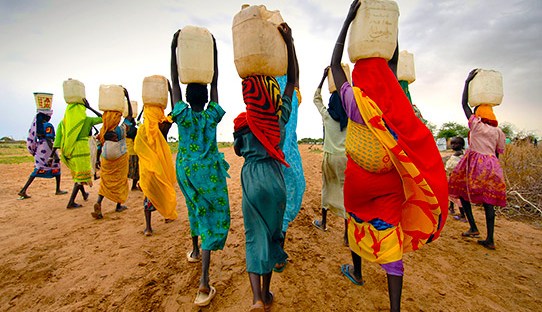
In many countries in Africa and beyond, women have very little power and are stuck in rigid gender roles and expectations. Women in Africa endure a long list of gender-based hardships including sexual and physical violence, limited decision-making, limited land and property owning, lack of proper education, and little to no access to reproductive healthcare. A recent study concluded that 37% of African women have been sexually abused by an intimate partner. In a culture where sexual violence is used as a tactic of war, women and girls live in fear or simply accept the foregone conclusion that it will happen to them. Women should never have to endure sexual or physical violence. There are no exceptions.
These women have been oppressed for thousands of years, so what has sparked this rapid change in gender equality in Africa? Well for one, in countries that have granted women more rights, freedoms, and job opportunities, they have seen economic growth when the world’s economy is in the toilet. By giving women more freedoms, education, and opportunities, Africa can create a more inclusive and thriving economy. In 2009, African leaders adopted the African Union Gender Policy that is working towards equal rights and freedoms for women and girls. This policy addressed the need to change the social and cultural constructs that have long constricted women’s rights, and even addresses that there are cultures that militate women’s rights. This policy sparked African Leaders to create the Women’s Decade 2010-2020, which is helping to speed up the process for women’s and girl’s rights. Halfway through that decade, Africa’s Agenda 2063 was proposed. Agenda 2063 is a 50-year plan to transform Africa and has a series of environmental, socio-cultural, scientific, political, economic, and technological goals set to be achieved over that time. While not every country is on board with equality, many countries are pushing for these changes. At this time, women own around a third of allAfrican businesses and hold nearly one-third of the seats in parliament in 11 countries. Countries like Rwanda, Liberia and Senegal have already seen the rewards of an inclusive government, and their success will hopefully spark other countries to adopt the same ideas.
One area in which women play a major role is food security. Women are involved in every step of the ‘food process’, including planting, growing, selling, purchasing and preparing. These women manage to tend to the crops and take care of their families, despite all the gender-based discrimination I mentioned previously. By empowering instead of oppressing these women, and allowing them to own their own properties for farming, there would be a significant increase in farm yields. With climate change causinglonger dry seasons and destroying the arable lands in Africa, a higher farm yield during these viable times would significantly help makeup for the predicted losses. By allowing women a better education, the ability to take out credit on their own, and access to technology they didn’t have in the past, woman can own thriving businesses that contribute to their community’s well being and the economy.
Although all of this is awesome, there is still so much that needs to be done to achieve gender equality. While allowing women more rights, freedoms, and better education to help the economy is great, things like reproductive health care and sexual violence aren’t being put in the forefront like they should. In sub-Saharan Africa, nearly 5 million women die every year from unsafe abortions. This number is not only astronomical, but completely preventable. Some of these women are in such desperate situations, that they risk their own lives by enduring unsafe and unsterile abortions. The African governments need to come together to figure out how to reduce this completely preventable number, whether through legalizing abortion or promoting the use of contraception. A recent statistic stated that on average, 400 African women die every singleday in a reproduction related complications. While some of these may not have been preventable, many of these deaths occurred simply from lack of reproductive health careavailable to women. The people who suffer the most from the lost of a mother are her children, and families often don’t bounce back well from the loss of their primary caregiver. With more aggressive health care initiatives, as well as continued efforts toward equality and education, great strides will hopefully be made toward gender equality for women in Africa.
Morgan McGoughran
From the article "Women in Africa Stories of Gender (In)Equality in South Africa. (2015). Retrieved from https://iycoalition.org/stories-of- gender-inequality- in-south-africa/
OSAA, Africa, UN and Africa, United Nations and Africa, Special Adviser, UN, United Nations NEPAD, African Union. (n.d.). Retrieved from http://www.un.org/en/africa/osaa/peace/women.shtml
Empowering Africa's women is the key to economic wealth – Europe's World. (2014). Retrieved from http://europesworld.org/2014/02/24/educating-africas- women-is-the-key- to-economic- wealth/
 Sustainable Journeys